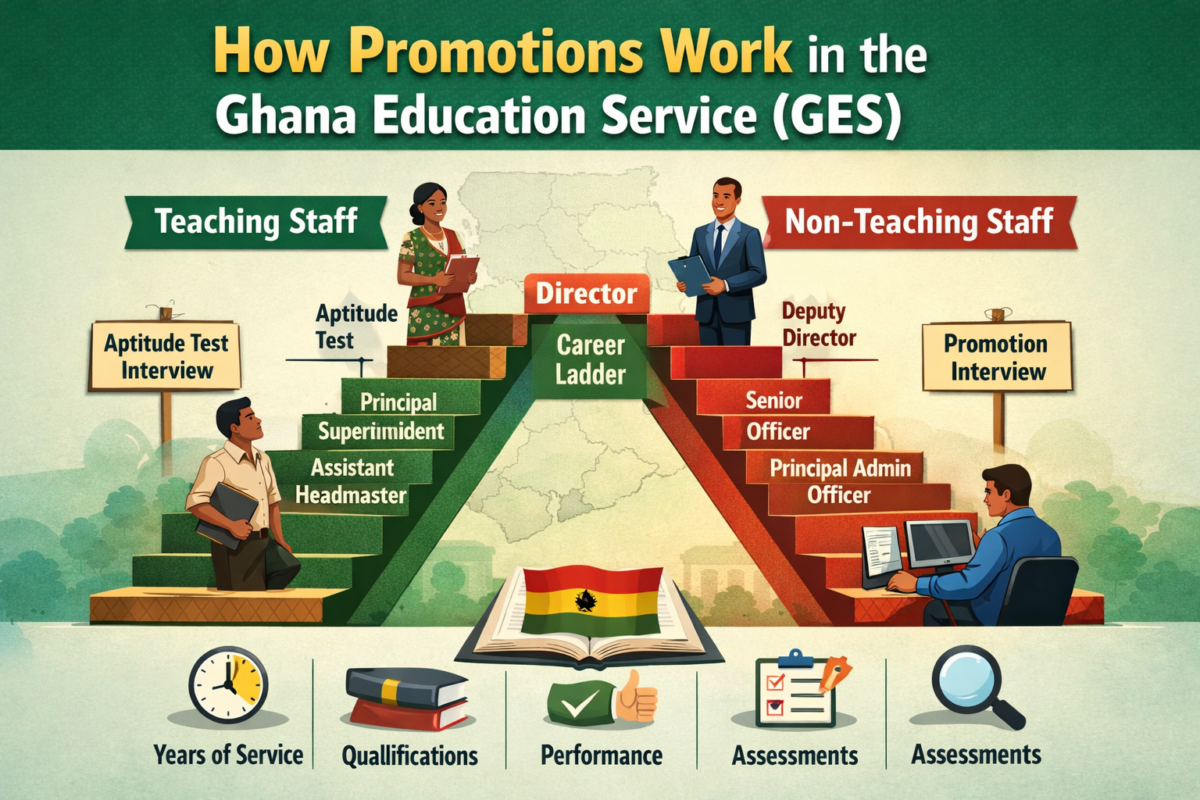
Promotion is an important part of career development within the Ghanaian public sector. For employees of the Ghana Education Service (GES), promotion indicates that a staff member has gained the experience and competence required to take on greater responsibilities within the service.
Most importantly, promotion within the Ghana Education Service often comes with an upward adjustment in the salary of the staff member. As staff move from one rank to another, their responsibilities and remuneration usually increase accordingly.
The promotion system in the Ghana Education Service is designed to ensure that qualified personnel progress through professional ranks. Within the Ghana Education Service, this framework is formally known as the Scheme of Service, which outlines the ranks, duties, and promotion pathways for staff.
Understanding how the promotion system works is very important. It helps staff of the service prepare effectively for career advancement opportunities.
This article provides an overview of the promotion structure in the Ghana Education Service, including the main categories of promotion and general requirements that staff should be aware of.
Ranks in the Ghana Education Service
Promotion in the Ghana Education Service is closely linked to the ranking system within the service. Staff move from one rank to another as they gain experience, qualifications, and demonstrate competence in their roles.
For teaching staff, ranks generally progress from junior ranks to senior ranks, eventually reaching administrative or leadership levels within the service.
Non-teaching staff also have their own ranking structure which determines their progression within administrative and operational roles.
Understanding these ranks is important because promotion in the GES essentially means moving from one rank to the next within the Scheme of Service. (See our detailed article on Ranks in the Ghana Education Service.)
Types of Promotions in the Ghana Education Service (GES)
Promotions within the Ghana Education Service generally fall into two main categories depending on the role of the staff member within the institution:
• Teaching Staff Promotions
• Non-Teaching Staff Promotions
Teaching Staff Promotion in the GES
Teaching staff promotions apply to educators who are directly involved in classroom instruction and academic leadership within schools.
These include teachers working in basic schools, senior high schools, and other educational offices such as district education offices, education units, regional offices, headquarters, and resource centres under the Ghana Education Service.
Promotion for teaching staff often reflects the number of years served, increasing levels of responsibility, professional experience, and leadership within the teaching profession.
Before 2021, teaching staff promotion typically took the form of an interview. This form of promotion considered factors such as teaching performance, professional qualifications, classroom management skills, and contribution to school development.
Interview panels were often made up of district directors, retired heads of secondary schools, and other experienced officers selected from district, regional, and headquarters offices within the Ghana Education Service.
Currently, as at the time of writing this article (2026), teaching staff promotion for senior ranks takes the form of an aptitude test.
Junior rank officers (below Principal Superintendent) normally have their work inspected and recommendations sent to headquarters for their promotion.
The current format and detailed requirements of Teaching Staff Promotion will be discussed in a separate article.
Non-Teaching Staff Promotion in the GES
Non-teaching staff promotions apply to employees who perform administrative, technical, and support roles within the education service.
These staff members play an essential role in ensuring that educational institutions function effectively. Their responsibilities may include administration, security services, food services, financial management, record keeping, logistics, environmental maintenance, and other operational duties that support the work of students, teachers, and school leadership.
Promotion for non-teaching staff allows them to move from one rank to another within their respective progression ladder.
Promotion usually considers factors such as number of years on the previous rank, job performance, professional experience, qualifications, and institutional needs.
Senior rank promotion of non-teaching staff within the service is usually conducted through interview.
A detailed explanation of the promotion procedures for these staff members will be provided in our article on Non-Teaching Staff Promotion in the Ghana Education Service.
General Promotion Requirements
Although promotion procedures differ slightly between teaching and non-teaching staff, and even from rank to rank, several common factors are usually considered during promotion processes within the Ghana Education Service.
Years of Service
Staff members are typically required to complete a minimum number of years in their current rank before becoming eligible for promotion.
Currently, the general minimum requirement is about four (4) years before a staff member progresses to the next rank. However, this may vary depending on specific promotion guidelines and circumstances.
Professional Qualifications
Relevant academic and professional qualifications can strengthen a candidate’s eligibility for advancement.
Higher academic qualifications may sometimes reduce the required number of years of service by one year. In some cases, additional qualifications may allow a staff member to be upgraded directly to a higher rank.
For example, a junior ranked staff member who successfully obtains a first degree may be upgraded directly to the beginning senior rank within the service.
Performance Evaluation
Work performance and professional conduct are important factors in determining readiness for promotion. Staff members who demonstrate professionalism, commitment, and competence in their roles are more likely to be recommended for advancement.
Promotion Interviews or Assessments
In many cases, candidates may participate in interviews or assessments designed to evaluate their competence and readiness for higher responsibilities.
Professional standards and licensing matters related to teaching are overseen by the National Teaching Council (NTC), which works alongside the Ghana Education Service to regulate professional teaching practice.
Preparing for Promotion in the Ghana Education Service
Staff members who intend to pursue promotion opportunities are encouraged to begin preparing well in advance. Effective preparation helps candidates demonstrate readiness for increased responsibilities and leadership roles.
Strengthening Professional Knowledge
Regardless of the category of promotion, understanding key professional areas such as educational policies, teaching methodology, the history of education in Ghana, and institutional procedures can significantly improve a candidate’s preparedness for promotion assessments.
Staff members are encouraged to remain informed about developments within the Ghanaian education sector and to continuously improve their professional knowledge.
Participating in Professional Development
Training workshops, seminars, and professional learning activities provide valuable opportunities for staff members to improve their skills and remain current with evolving educational practices.
Active participation in professional learning communities can strengthen a candidate’s knowledge base for promotion.
Common Challenges Staff Face During GES Promotion
Many staff members preparing for promotion encounter challenges that may affect their readiness. Some of the most common challenges include:
• Limited access to preparation materials
• Application procedures that sometimes overwhelm staff
• Seeking assistance from inexperienced café attendants during application, which may lead to initial disqualification
• Uncertainty about promotion requirements
• Lack of guidance on promotion expectations
Understanding the promotion process and preparing systematically can help staff overcome these challenges and approach promotion opportunities with greater confidence.
GH Educate provides resources for staff preparing for promotion within the Ghana Education Service, including study topics, sample promotion questions with answers, and preparation tips.
Other Related Guides on GES Promotions
Because the promotion system within the Ghana Education Service involves several stages and requirements, additional guides have been prepared to provide more detailed information on specific aspects of the process.
These include:
• Teaching Staff Promotion in Ghana: Requirements and Process
• Non-Teaching Staff Promotion in GES
• How to Prepare for GES Promotion Interviews
• Common Questions in Teacher Promotion Exams
These guides provide practical information and preparation tips for staff members seeking advancement within the Ghana Education Service.
Conclusion
Promotion within the Ghana Education Service is an important step in the professional journey of both teaching and non-teaching staff.
By having a clear understanding of the promotion structure, meeting eligibility requirements, following the correct application procedures, and preparing effectively, staff members can position themselves for successful career advancement. Continuous professional development, awareness of institutional policies, and commitment to improving professional skills remain essential factors for achieving career growth within the Ghana Education Service.