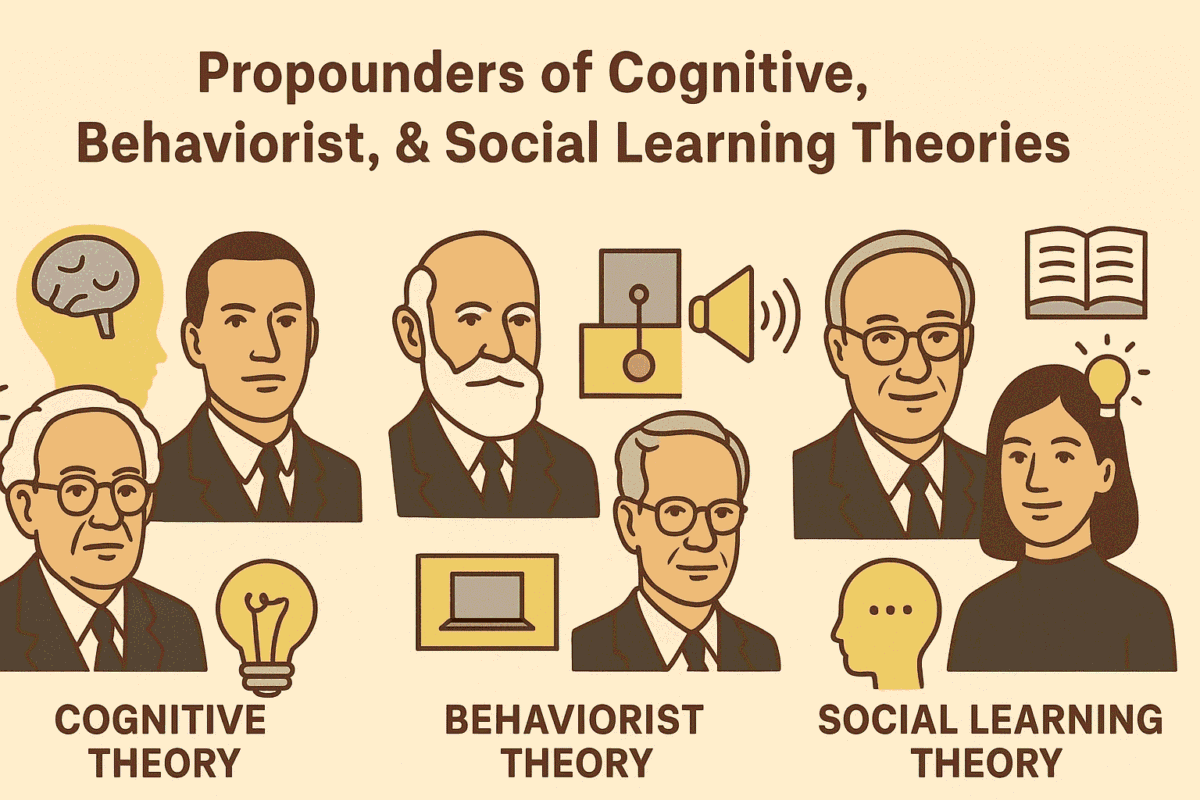
Understanding how people learn is the foundation of modern education. Over the last century, several influential theorists have shaped our understanding of human learning, behavior, motivation, and cognitive development. Among the most impactful are the scholars behind Cognitive Learning Theory, Behaviorist Learning Theory, and Social Learning Theory.
This article outlines the key persons associated with each school of thought. In this article we do our best to summarize their contributions to education and psychology.
Cognitive Learning Theory : Key Propounders
Cognitive Theory focuses on how people think, perceive, process information, and solve problems. It emphasizes internal mental processes rather than external behaviors.
a. Jean Piaget (1896–1980)
Piaget is considered the father of Cognitive Development Theory.
His major contributions include:
- Identifying stages of cognitive development (sensorimotor, preoperational, concrete operational, formal operational)
- Showing how children actively construct knowledge
- Demonstrating that cognitive growth happens through assimilation and accommodation
Piaget’s work transformed child development and classroom instructional methods.
b. Lev Vygotsky (1896–1934)
Vygotsky emphasized the role of social interaction in learning.
His key concepts include:
- Zone of Proximal Development (ZPD)
- Scaffolding
- Learning as a socially mediated process
Vygotsky shifted focus from individual learning to the role of culture, language, and community.
c. Jerome Bruner (1915–2016)
Bruner introduced the idea that learning is an active, problem-solving process.
His contributions include:
- Discovery learning
- Spiral curriculum
- Modes of representation (enactive, iconic, symbolic)
Bruner promoted instructional methods that stimulate inquiry and deeper thinking.
Behaviorist Learning Theory : Key Propounders
Behaviorism focuses on observable behavior and posits that learning is driven by environmental stimuli, reinforcement, and punishment.
a. Ivan Pavlov (1849–1936)
Founder of Classical Conditioning.
His experiments with dogs showed that:
- Behavior can be learned through association
- Neutral stimuli can become conditioned stimuli
Pavlov’s work laid the foundation for behavioral modification.
b. John B. Watson (1878–1958)
Watson formalized Behaviorism as a scientific discipline.
His major ideas:
- Psychology should study only observable, measurable behavior
- Learning results from stimulus–response interactions
Watson’s approach shaped early experimental psychology.
c. B.F. Skinner (1904–1990)
Skinner developed Operant Conditioning, which explains learning through consequences.
Key concepts include:
- Positive and negative reinforcement
- Punishment
- Schedules of reinforcement
- Behavior shaping
Skinner’s work remains influential in classroom management and instructional design.
Social Learning Theory : Key Propounders
Social Learning Theory bridges cognition and behavior by emphasizing learning through observation, imitation, and modeling.
a. Albert Bandura (1925–2021)
Bandura is the founder of Social Learning Theory and later Social Cognitive Theory.
His contributions include:
- Observational learning
- The Bobo Doll Experiment
- Concepts of self-efficacy and reciprocal determinism
Bandura’s theory demonstrates that people learn not only through direct experience but also by watching others.
| Theory | Key Figures | Major Contributions |
|---|---|---|
| Cognitive Theory | Piaget, Vygotsky, Bruner | Mental processes, cognitive stages, scaffolding, discovery learning |
| Behaviorist Theory | Pavlov, Watson, Skinner | Conditioning, reinforcement, punishment, observable behavior |
| Social Learning Theory | Bandura | Observational learning, modeling, self-efficacy |
Conclusion
Cognitive, Behaviorist, and Social Learning Theories all contribute valuable perspectives to the understanding of how individuals learn.
- Cognitive theorists highlight mental processes.
- Behaviorists emphasize reinforcement and environmental influence.
- Social learning theorists explain how observation and social context shape behavior.
Together, these theories form the foundation of modern educational psychology and remain central to teaching, curriculum design, counseling, and behavior management.