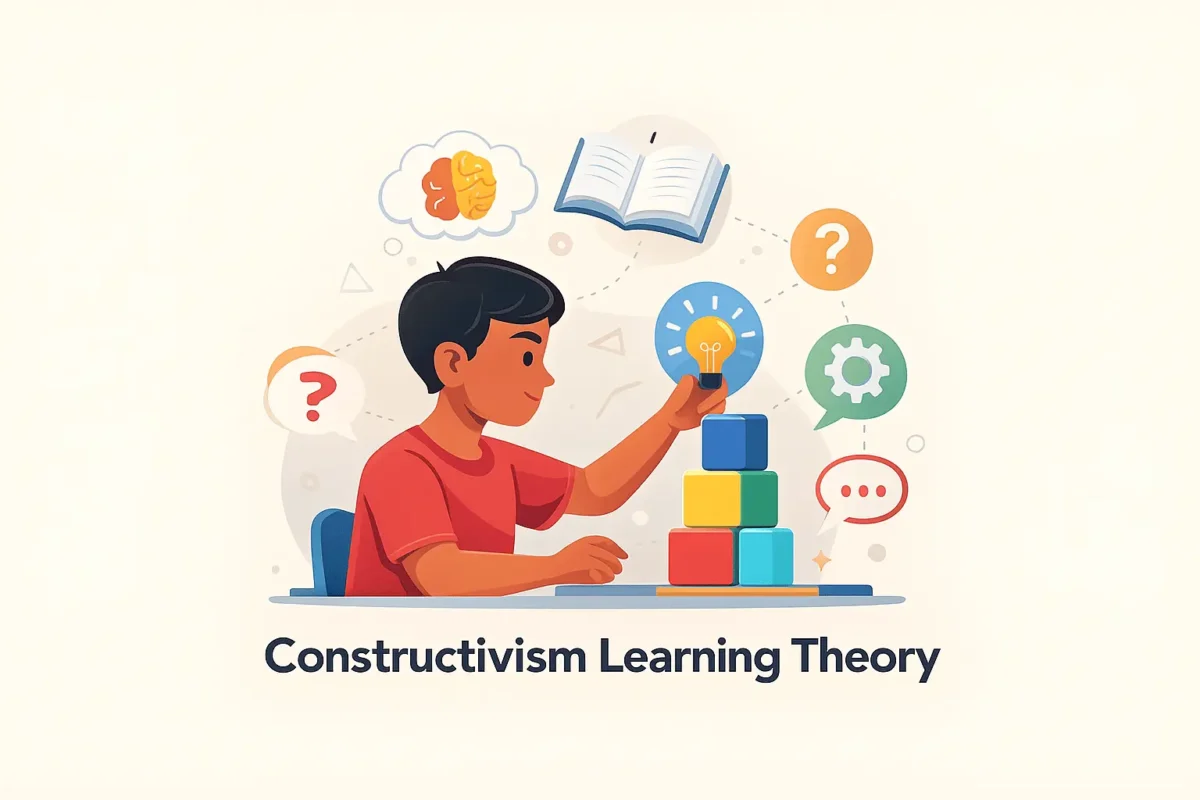
What Is Constructivism?
Constructivism is a learning theory that explains that learners build knowledge for themselves. Instead of receiving information passively, learners make meaning by connecting new ideas to what they already know. Learning becomes active, practical, and personal.
In constructivist teaching, the learner is at the center. The teacher guides, supports, and creates opportunities for exploration rather than simply giving answers. This approach helps learners understand deeply, think critically, and apply ideas to real world situations.
Key Propounders of Constructivism
Constructivism was developed through contributions from several influential theorists:
Jean Piaget in Constructivism
Piaget is one of the main founders of constructivism.
He explained that children learn by interacting with their environment and moving through stages of cognitive development.
Lev Vygotsky in Constructivism
Vygotsky expanded constructivism with a social dimension.
He introduced concepts such as the Zone of Proximal Development (ZPD) and scaffolding, stressing that learning happens through interaction with others.
Jerome Bruner
Bruner emphasized discovery learning and the idea that learners construct knowledge at all stages of development.
He supported spiral learning and guided exploration.
Everyday Classroom Use Cases
Constructivism works well in modern classrooms. Below are simple, common examples of how constructivism is used especially in classrooms:
- Group Work and Peer Learning
Learners discuss a topic in small groups, share ideas, and solve problems together.
This builds understanding through interaction, a core idea in Vygotsky’s social constructivism.
- Hands-On Activities
Science experiments, maths manipulatives, practical demonstrations, and fieldwork help students build knowledge through direct experience.
- Inquiry-Based Learning
Instead of giving answers, the teacher asks guiding questions such as:
“What do you think will happen?”
“How did you get that answer?”
This reflects Bruner’s discovery learning approach.
- Reflection Exercises
Learners write or speak about what they learned, how they learned it, and how it connects to previous knowledge.
This aligns with Piaget’s emphasis on making meaning internally.
- Using Real-Life Examples
Teachers link lessons to everyday activities—shopping, local events, school routines, or community challenges—so learners actively connect schoolwork to real life.
Why Teachers Must Use Constructivism
Constructivism improves learning because it:
- Encourages active participation
- Builds problem solving and critical thinking skills
- Supports collaboration and communication
- Makes learning meaningful and long lasting
- Helps learners take responsibility for their progress
These principles make constructivism one of the most effective learning approaches in modern education.