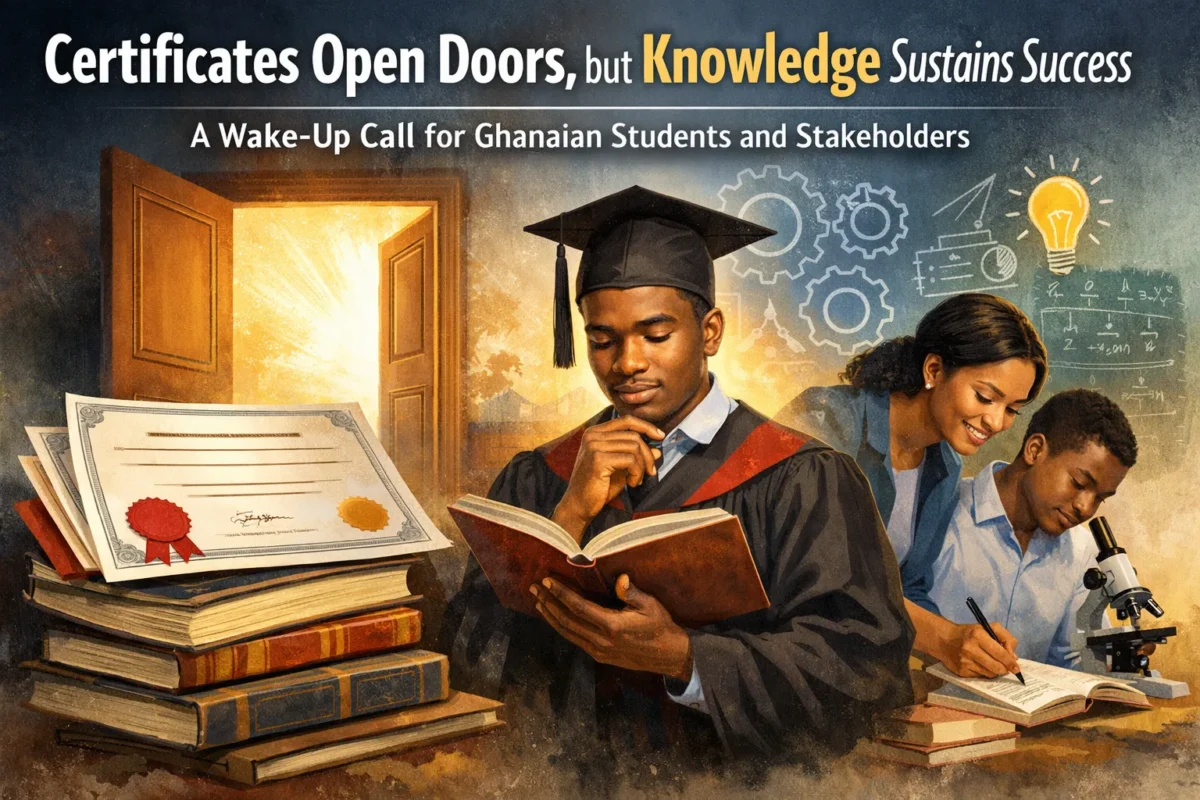
In contemporary Ghana, certificates have assumed immense value. They open pathways to higher education, employment opportunities, scholarships, and social mobility. From BECE and WASSCE to diplomas and degrees, academic credentials are widely celebrated. However, beyond the applause of graduation ceremonies lies a fundamental truth: certificates may open doors, but it is knowledge, discipline, and character that determine whether one remains relevant and respected within those doors.
Across schools, colleges, and workplaces, a growing gap is evident between certification and competence. Many students excel in examinations yet struggle to apply concepts in practical or professional settings. Others rely heavily on memorization and shortcuts, only to encounter confusion when independent thinking, responsibility, and sound judgment are required. This disconnect between academic success and real understanding poses a serious challenge to Ghana’s educational and human development agenda.
Education, in its true sense, is not merely an exercise in passing examinations. It is a lifelong process that shapes critical thinking, builds ethical judgment, and develops the capacity to solve complex problems. A certificate merely affirms that certain academic requirements were met at a specific point in time; it does not confer wisdom, professionalism, or readiness for leadership. When students pursue grades without pursuing understanding, they sacrifice long-term competence for short-term recognition.
The realities of life and work are unforgiving. Outside the examination hall, challenges do not come in structured questions with guided answers. Employers, institutions, and communities demand initiative, adaptability, integrity, and depth of knowledge. In moments of crisis or responsibility, certificates remain silent. It is one’s understanding, values, and ability to apply knowledge that speak—and these qualities alone sustain credibility, influence, and effectiveness.
This reality explains why some individuals with impressive academic credentials struggle in leadership and professional roles, while others with fewer qualifications but stronger mastery and experience excel. Qualifications may grant access, but competence secures continuity. Without sound judgment and deep understanding, authority becomes fragile, and success short-lived.
For Ghanaian students, this is a timely call to re-examine priorities. Learning must go beyond examination preparation to genuine comprehension, skill development, and personal growth. Reading to understand, questioning to learn, and practising to master must replace cramming to pass. In an era shaped by innovation, technology, and global competition, the ability to think critically and learn continuously is indispensable.
As Ghana invests heavily in education, students must also invest in themselves. Certificates should be viewed as foundations, not final destinations. Knowledge, discipline, and character are the pillars that sustain success. When the doors opened by certificates close behind you, it is these enduring qualities that will keep you standing with confidence, relevance, and honour. This is a wake-up call for Ghanaian students and all education stakeholders: let us nurture minds, not just papers, and let learning be transformative, not merely transactional.
Keep following GH EDUCATE for credible news and updates.