

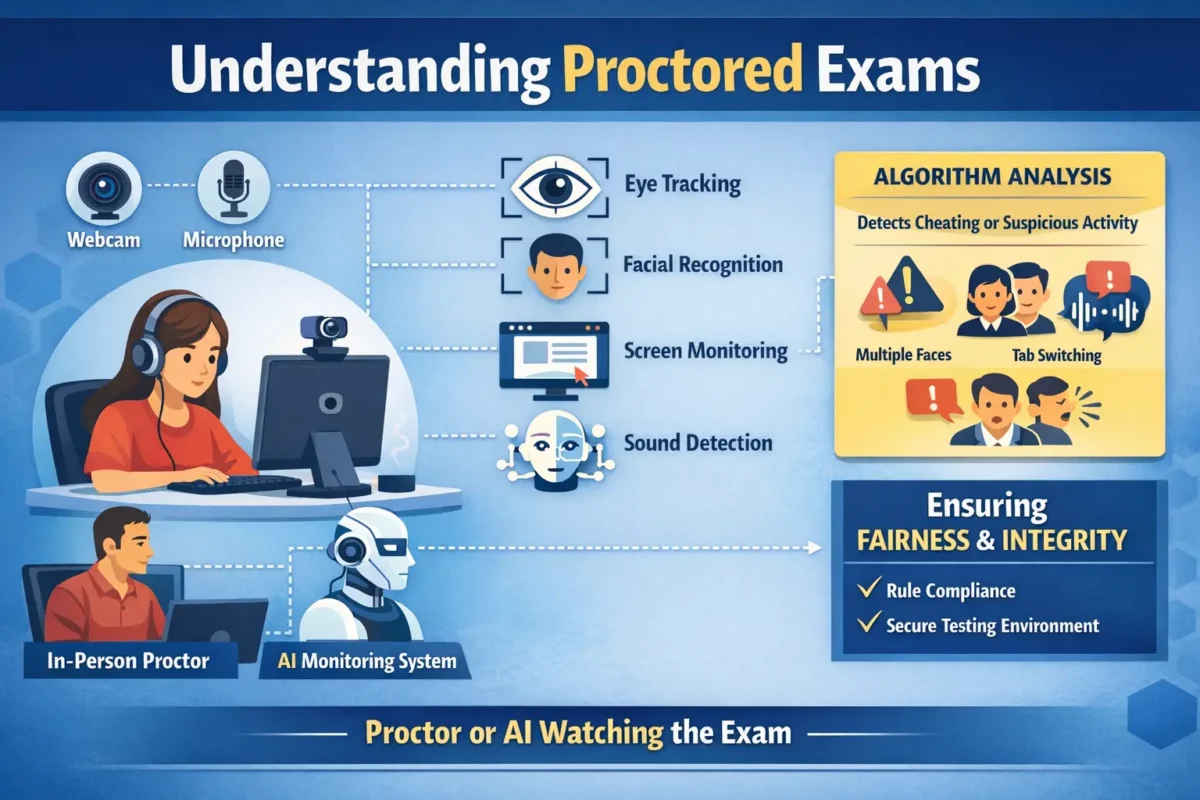
In today’s digital learning era, examinations are no longer confined only to physical classrooms. One major innovation that has transformed assessment systems worldwide is the proctored exam. Whether you are a student preparing for a certification test or an educator planning online aptitude test or assessments, understanding how proctored exams work is essential.
This article explains the meaning of a proctored exam, its origin, types, how it works, and its benefits in clear and simple terms.
What is a Proctored Exam?
A proctored exam is a test that is supervised by an authorized person (called a proctor) or a monitoring system that uses programmed algorithms to ensure that exam rules are followed and cheating is prevented. These algorithms are designed to analyze behaviors such as eye movement, facial recognition, background noise, and screen activity to detect any suspicious actions during the examination.
The supervision can happen physically in an exam hall under the watch of a human invigilator, or remotely through technology such as webcams, screen monitoring software, microphones, and Artificial Intelligence systems powered by automated decision-making algorithms.
In simple terms, a proctored exam is any examination where a person or a smart computer system uses structured rules and algorithms to monitor candidates and maintain fairness, credibility, and integrity.
How Did Proctored Exams Begin?
Proctored exams have existed for centuries in traditional educational systems. In early days, universities and other institutions assigned invigilators to monitor students during written examinations to prevent malpractice.
With the rise of computer-based testing in the late 20th century, organizations began using secure testing centers. Companies like Pearson VUE pioneered structured, technology-driven exam supervision in controlled environments.
The real transformation came during the growth of online education. Platforms such as Coursera and large testing bodies like ETS introduced remote proctoring systems. This allowed students to take exams from home while still maintaining exam integrity.
The COVID-19 pandemic further accelerated the global adoption of remote and AI-powered proctoring systems.
It is important to note that Ghana used this type of exam in the recent Security Services Aptitude Test for the applicants.
Types of Proctored Exams
There are several types of proctored exams currently in use:
1. In-Person (Traditional) Proctored Exams
These are conducted in physical exam halls or test centers. A human invigilator supervises candidates to ensure rules are followed.
2. Live Online Proctoring
In this method, students take exams remotely while a human proctor monitors them in real time via webcam and microphone.
3. Recorded Proctoring
The exam session is recorded through video and screen capture. The recording is reviewed later by exam administrators to identify suspicious behavior.
4. AI Proctored Exams (Automated Proctoring)
Artificial Intelligence software monitors students automatically. It tracks eye movement, unusual sounds, multiple faces on camera, and suspicious screen activity. Any irregularities are flagged for further review.
How Proctored Exams Work
Although the process may differ slightly depending on the platform, most proctored exams follow these steps:
1. Identity Verification
Before starting the exam, the candidate must verify their identity. This may involve:
- Showing a government-issued ID
- Taking a live photo
- Facial recognition matching
2. Environment Check
Students may be required to:
- Show their room using the webcam
- Remove unauthorized materials
- Ensure no one else is present
3. Active Monitoring
During the exam:
- Webcam records video
- Microphone captures audio
- Screen activity is monitored
- Browser restrictions may be applied
If suspicious behavior occurs (e.g., switching tabs frequently or someone entering the room), the system flags the activity.
4. Review and Evaluation
Flagged incidents are reviewed by human examiners to determine whether malpractice occurred.
Benefits of Proctored Exams
Proctored exams offer several advantages for both institutions and students.
1. Ensures Academic Integrity
They reduce cheating and protect the credibility of certificates and qualifications.
2. Convenience and Accessibility
Remote proctored exams allow students to take tests from their homes, eliminating the need for travel.
3. Cost-Effective
Institutions can reduce expenses related to physical venues, printing, and logistics.
4. Flexible Scheduling
Students can choose suitable exam times within approved windows.
5. Global Reach
Universities and certification bodies can assess candidates worldwide without requiring them to visit specific locations.
6. Faster Processing
Digital systems often allow quicker scoring and result processing.
Challenges to Consider
While proctored exams are beneficial, they also come with challenges:
- Internet connectivity issues
- Privacy concerns
- Technical hitches
- False flags caused by normal movements
Institutions must balance security with fairness and student comfort.
As online learning continues to grow globally, proctored exams will remain a key tool in maintaining trust and credibility in academic and professional certifications.
If you are preparing for a proctored exam, ensure you have a stable internet connection, a quiet environment, and understand the rules beforehand. Proper preparation can help you complete your exam smoothly and confidently.




Interesting