
School fees and levies remain one of the most sensitive issues headteachers deal with daily. While schools need resources to function, the law is clear: no child’s right to education should be sacrificed because of fees or arrears. Understanding where authority ends and where the law begins is critical for every headteacher.
This article explains what the Children’s Act, 1998 (Act 560) expects of school heads and how to manage fees and arrears lawfully, ethically, and professionally.
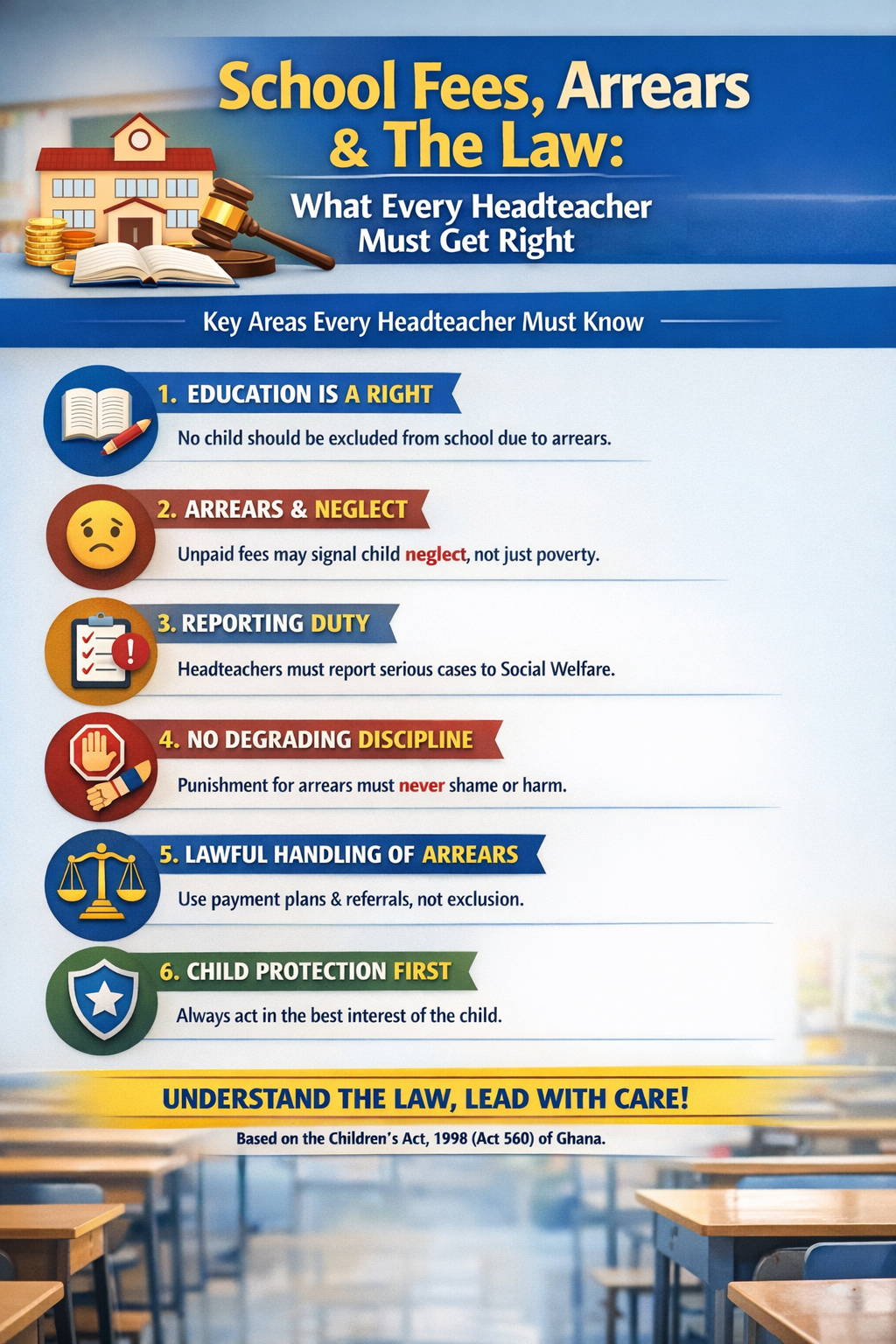
1. Education Is a Legal Right, Not a Privilege
The Children’s Act establishes that every child has a right to education and well-being. This means:
- A child must not be denied access to education because parents fail to meet financial obligations.
- Excluding a child from class, exams, or school activities solely due to arrears raises legal and child protection concerns.
For headteachers, this shifts the mindset from “fees enforcement” to “child protection with administrative balance.”
2. Arrears Are a Parental Responsibility — Not the Child’s Fault
The Act places the duty of maintenance squarely on parents and guardians, including the provision of basic education.
What this means in practice:
- Parents default, not children.
- Punitive actions against learners (sending home, humiliation, isolation) may amount to indirect punishment of poverty.
- Persistent non-payment may indicate neglect, not indiscipline.
A headteacher’s role is not to punish the child, but to identify the underlying issue.
3. When Arrears Become a Child Protection Issue
The law recognizes neglect as a situation where a child’s basic needs—education included—are not being met.
Red flags headteachers should watch for:
- Chronic absenteeism linked to unpaid fees
- Learners withdrawn from school to work
- Repeated lack of books, uniform, or food
- Emotional distress tied to financial pressure
At this point, arrears are no longer just an administrative issue—they may be a care and protection concern.
4. Reporting Is a Legal Duty, Not an Option
Under the Children’s Act, any person with information about a child in need of care and protection must report it to Social Welfare.
For headteachers, this means:
- Document patterns of non-attendance and deprivation
- Engage parents formally and respectfully
- Refer persistent cases to the District Social Welfare Department through appropriate channels
Reporting is protective, not punitive. It is meant to support families—not criminalise them.
5. Discipline Must Never Be Used to Enforce Payment
The Act is explicit: discipline must not be degrading or unreasonable.
Therefore, headteachers must avoid:
- Public shaming over arrears
- Corporal punishment linked to non-payment
- Denial of meals, lessons, or learning materials as punishment
Using discipline to enforce fees exposes schools and heads to legal and reputational risk.
6. Lawful Ways Headteachers Can Manage Arrears
The law does not say schools should ignore fees. It says children must be protected.
Best practices include:
- Confidential engagement with parents
- Flexible payment plans
- Referral to PTA, School Welfare Committees, or Social Welfare
- Keeping the child in class while administrative processes continue
- Clear school policies aligned with national child protection laws
Good leadership balances financial sustainability with child rights compliance.
7. The Headteacher as a Child Rights Gatekeeper
Under Act 560, headteachers are more than administrators. They are:
- First-line child protection actors
- Duty bearers under the welfare principle
- Leaders expected to uphold dignity, fairness, and legality
When handled well, arrears management can strengthen trust, improve retention, and protect the school from legal trouble.
A school that keeps children learning while addressing arrears lawfully is not weak — it is compliant, ethical, and professional.
Headteachers who understand the law and the specific role they play as a way of not losing their authority are known to be professional and competent. Headteachers must always lead with the law in` mind.
Follow GH Educate for more